The Invisible Calculus of "No":
Why the Neighborhood Revolt Against Big Tech is a Rational Self-Defense
September 30, 2026
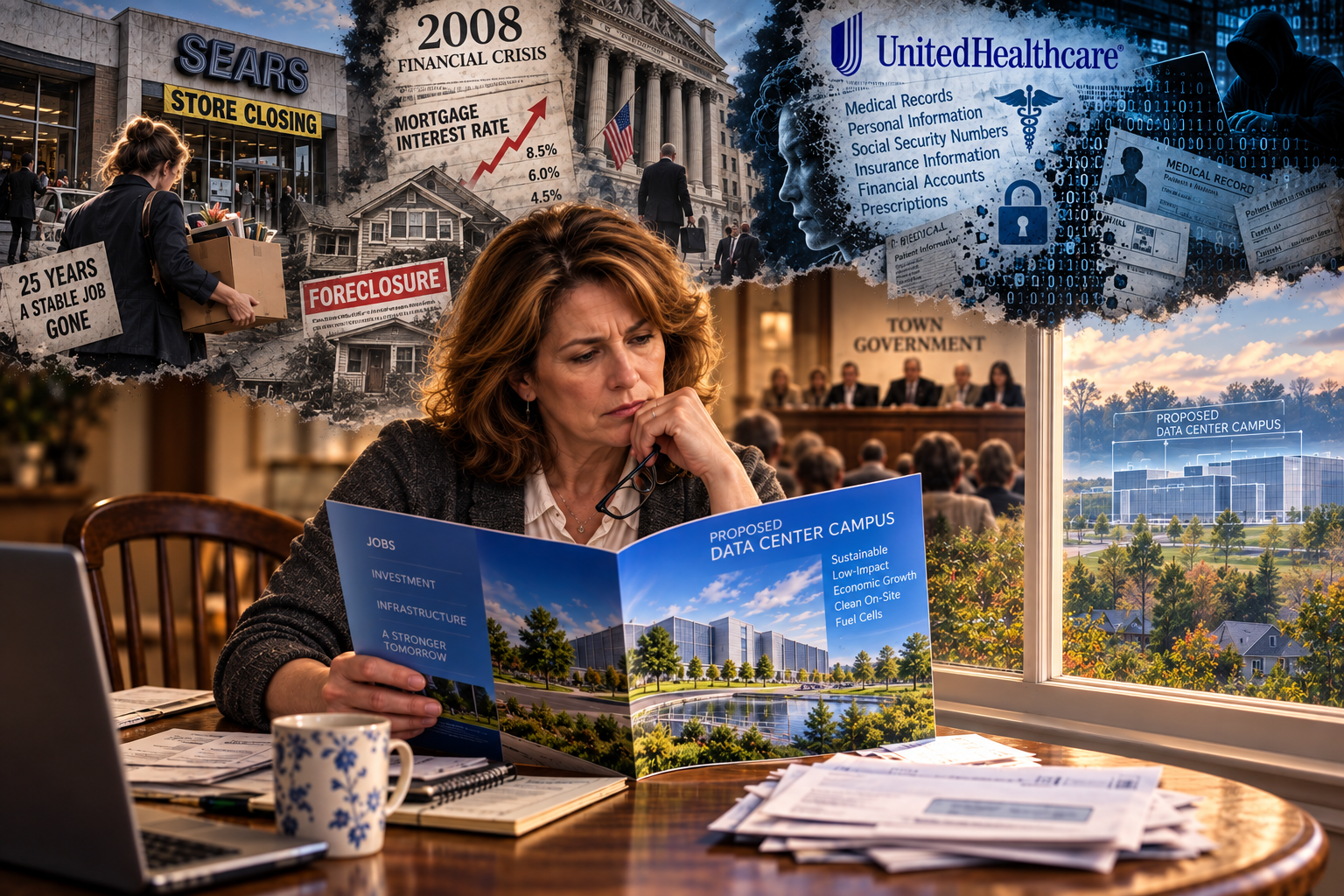
As Lynn sits down to go through her mail, the glossy, electric-blue brochure sitting on the kitchen table looks completely harmless. It features a pristine, digital rendering of a proposed data center campus, complete with an estate manicured lawn, young trees, and a bold headline promising "sustainable, low-impact economic infrastructure powered by clean on-site fuel cells."
To the municipal planners and the tech developers fast-tracking the project, it is a flawless business proposal. To them, the upcoming zoning board vote in the high school auditorium is a simple formality. Anyone standing at the microphone to object to a quiet computer warehouse that produces no traffic or public-school burden must be a Luddite—a short-sighted contrarian standing in the way of progress in the digital age based on undefinable fears of progress.
But the citizen sitting at the table, staring at that brochure, isn’t looking at a simple blueprint. She is looking through the prism of a thirty-year ledger of lived experience.
To the common citizen, the decision to vote "no" isn’t an uneducated reflex against technology; even if only unconsciously, it is the terminal output of a highly logical, deeply calculated internal decision tree. It is a defensive perimeter pieced together by a person who has spent a lifetime watching institutions fail, corporate leaders extract wealth, and regular people get left holding the bag.
Before the citizen ever steps a foot in the auditorium, the tech industry’s promises pass through a gauntlet of lived history.
The first branch of that decision-tree calculation belongs to the ghost of Sears.
Long before the word "cloud" meant anything to the average consumer, business was understood to be a mutual covenant: you dedicated twenty or thirty years of your life to a stable American institution, and your hard work was met with traditional performance and a secure retirement.
But this citizen remembers the exact day that covenant was shattered by the slick, modern financial engineering of Eddie Lampert. They watched a corporate mastermind intentionally split a functional company into a Rubik’s Cube of operating shells and a real estate property companies, deliberately bleeding the retail stores dry with artificial rent while keeping the pristine real estate for his own fund.
As stated in The American Prospect, “Eddie Lambert dismantled Sears by operating the retailer as a personal hedge fund through predatory financial engineering rather than building a viable retail strategy. He systematically stripped the company of assets, starved physical locations of capital investment, and created a hyper-competitive corporate structure that sabotaged internal cooperation.”
Tens of thousands of stable jobs vanished into thin air, families were displaced, and a legacy brand rotted from the inside out, while the executive walked away holding the underlying asset. After 25 years of rising from a cashier to a department manager at Sears, Lynn was left jobless and fighting for a pension from a company pension fund that Eddie was maneuvering to pocket.
When the data center brochure promises "local economic growth," Lynn’s internal algorithm instantly flags the lie. She recognizes the data center developer’s enticing representations as the modern evolution of the asset-stripper—a corporate entity using anonymous shell companies to pack a local site with environmental liabilities and presently unknown landmines while keeping the highly valuable utility rights and land insulated in a separate legal bucket where the community can never touch them.
And now Lynn processes a second limb on her decision tree.
The memory of that Sear’s betrayal was hardened into permanence by recalling the bitter reality of the 2008 financial crisis. Citizen Lynn, along with many thousands of others, remembers watching her home equity evaporate and her mortgage interest rate soar overnight while the federal government engineered multi-billion-dollar bailouts for Wall Street banks deemed "too big to fail."
She remembered the burning injustice that the taxpayers picked up the trillion-dollar bill while almost nobody was held accountable or went to jail. The legal system established a dangerous moral hazard, treating massive corporate crimes as simple civil math problems where regulatory fines are paid out of shareholder funds without a single executive facing personal accountability.
All while she walked a daily tightrope trying to hand onto the home she had worked so hard to acquire.
Without true criminal liability for white-collar negligence, Lynn and millions of others know that modern tech titans like Mark Zuckerberg have a legal license to operate recklessly. Section 230 of the Communications Act of 1934 was just the tip of “get out of jail free” card and the “White House Accord on Super Intelligence" trusting the AI industry to self-police serving as a roadmap for the future.
If the data center's continuous low-frequency noise hums through bedroom walls at night, or if its infrastructure creates a local hazard such as its backup diesel generators filling her neighborhood with highly noxious nitrogen oxide (NOx) emissions, Lynn knows from multiple past examples that the tech executives won't face prison time. The company will simply pay a minor fine as a cost of doing business, and the neighborhood will be left to survive a mess not of its own creation.
As her eyes blink with frustration, Lynn is about to process a third limb on her decision tree. It is a more recent, deeply intimate violation, and it arrived in her mailbox under the guise of “corporate regret”.
It might as well of had an electric-blue background!
Lynn relives the moment she received the letter notifying her that her entire digital existence—her birthday, her home address, her Social Security number, her financial history, and her highly private medical charts—had been hacked and dumped onto the dark web following the massive breach at UnitedHealthcare. Lynn remembers the immediate sense of vulnerable exposure, followed quickly by the sickening realization of absolute abandonment. The multi-billion-dollar health conglomerate didn’t offer a real solution or step forward to fix the chaos they introduced into her life. Instead, they handed her a toothless, transactional gesture: two years of free credit monitoring.
By the time credit monitoring picks up a threat, you have already been hacked.
To Lynn, the calculation was simple and infuriating. A leaked Social Security number is compromised forever, not for twenty-four months. Yet the corporate system allowed UnitedHealthcare to treat her stolen identity as an acceptable line-item expense. No executives lost their bonuses, no board members faced criminal negligence charges, and the company simply hid behind their corporate veil while Lynn was left entirely on her own to navigate the lifelong threat of identity theft and financial ruin.
Again, she had done all of the right things and was left in a world of hurt not of her own making.
Now, sitting at her kitchen table, Lynn connects the dots between the dark web and the physical dirt of her neighborhood. The tech developer’s brochure promises "impenetrable encryption, data security, and absolute environmental safety" for the proposed fuel cell microgrid. But Lynn’s decision tree has already processed the data. She knows that if a trillion-dollar industry views her private life as an expendable harvest and takes a hike the moment their negligence creates a crisis, they will do the exact same thing to her and her property.
She looks up from the table and gazes out of her home’s front window. The final branch of her decision tree locks into place as she looks at the town she lives in.
She sees a local government that while making bold assurances, lacks both the competence and the integrity to police a global tech monopoly. If the mayor and the local code enforcement officers routinely pick and choose which basic laws to enforce on the streets, how can they possibly monitor complex low-frequency decibel levels, groundwater loops, or diesel exhaust plumes at 3:00 AM?
The town council is desperate for a quick tax windfall to patch their own mismanaged pork-stuffed budget, and Lynn knows they will gladly look the other way when the neighborhood begins to suffer. Or, perhaps, they will have already moved to a lower-tax state as they run from the mess they created.
They are eager to trade the quiet enjoyment of her neighborhood for a corporate revenue engine, blind to the history that dictates what happens next.
Lynn puts down the electric-blue brochure, stands up from the table, and grabs her coat. When she stands at the microphone in the high school auditorium in an hour, the town governance in unison with the tech companies hired guns armor-coated in their $5000 suits will look at her and see a Luddite—an obstacle to progress standing in the way of the inevitable future.
But they don't see the chronological ledger running in her head.
Her "thumbs-down" is not an uneducated reflex; it is an act of rational, history-backed self-defense. In a world where capitalism has been twisted into institution-destroying asset extraction, where tech companies have lost all trust by assuming zero responsibility, and where the government has similarly lost its credibility by abandoning its commitment to the people it is supposed to represent, Lynn knows that the physical boundary of her backyard is the only firewall she has left to defend herself and her happiness in this world.
It is easy for the tech titans and political leaders to dismiss her as a solitary gadfly, a relic of a bygone era who simply refuses to understand the “cloud”…the future whose technology she uses and depends on. But they fail to realize that Lynn is not an exception; she is the rule. She is the predictable, inevitable product of the very cynical system they engineered.
And if you would like to meet Lynn, please just go look in the mirror.
 RightPage